Latest Breakthroughs in Quantum Computing 2024: The Year Machines Learned to Fix Their Own Mistakes
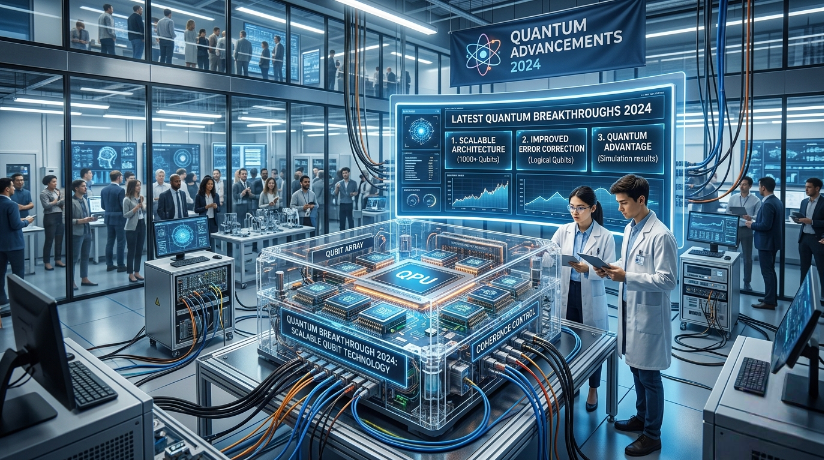
Something strange happened in quantum computing labs this year. For decades, researchers warned that adding more qubits to a quantum machine made errors worse, not better. Then, almost overnight, that assumption fell apart. The latest breakthroughs in quantum computing 2024 didn’t just push performance numbers higher. They flipped a core problem of the field on its head, and the ripple effects are still spreading through labs, boardrooms, and government policy offices today.
If you’ve been half-following quantum computing news and wondering whether any of it actually matters yet, you’re not alone. This article walks through what really happened, why scientists are genuinely excited (not just marketing-excited), and what it means for industries watching from the sidelines. No jargon dumps, no hype for hype’s sake — just a clear-eyed look at where things stand.
Why 2024 Was a Turning Point for Quantum Computing
Quantum computing has a credibility problem, and honestly, it’s earned it. For years, companies promised revolutionary machines “five years away,” and five years kept passing without much to show. So when people hear about the latest breakthroughs in quantum computing 2024, a little skepticism is healthy. But this year was different in one crucial way: the milestones weren’t just bigger numbers. They addressed the field’s oldest and thorniest obstacle — errors.
Quantum bits, or qubits, are notoriously fragile. Stray heat, vibration, or even cosmic rays can knock them out of their delicate quantum state. Classical computer bits don’t have this problem; a 1 stays a 1 unless you deliberately change it. Qubits, by contrast, are constantly leaking information into their environment, a process called decoherence. Historically, engineers assumed that packing more qubits together to fix errors would just create more error sources, faster than you could correct them.
That assumption is exactly what got challenged this year. Researchers demonstrated, for the first time under real experimental conditions, that error rates could actually drop as qubit count increased — provided the underlying hardware quality crossed a specific threshold. Think of it like a choir: below a certain skill level, adding more singers just adds more wrong notes. Cross that skill threshold, though, and more singers start blending into something cleaner and more harmonious. That’s roughly the shift quantum hardware experienced in 2024.
The “Below Threshold” Milestone Explained
The technical term for this moment is crossing the “error correction threshold,” and it’s been the holy grail of quantum engineering since the 1990s. In practice, it means a quantum processor’s logical qubits — the error-corrected, more reliable version of physical qubits — became more stable as researchers scaled the system up rather than less stable.
Google’s Quantum AI team was first to publicly demonstrate this behavior with its Willow processor, announced in December 2024. <cite index=”1-1″>The chip contained 105 physical qubits capable of retaining a quantum state for nearly 100 microseconds — five times longer than the company’s previous generation of hardware.</cite> More importantly, <cite index=”1-1″>as researchers added more qubits to the system, the error rate dropped exponentially instead of climbing, marking the first time a system operated “below threshold.”</cite>
Google’s quantum lead, Hartmut Neven, called it <cite index=”1-1″>the most convincing prototype yet of a scalable logical qubit</cite>, and it’s easy to see why researchers across the industry took notice. This wasn’t an incremental tweak. It was proof that the theoretical path toward large, reliable quantum machines actually works in physical hardware, not just on a whiteboard.
Google’s Willow Chip: A Deep Dive Into the Headline-Grabbing Breakthrough
Let’s slow down and unpack Willow a bit more, since it’s become the poster child for the latest breakthroughs in quantum computing 2024. The chip made headlines partly because of a jaw-dropping benchmark result: <cite index=”1-1″>it completed a standard computation in under five minutes that would take a leading classical supercomputer roughly 10 septillion years to finish.</cite> For context, that’s a number so large it dwarfs the age of the universe many times over.
Now, before you picture Willow solving climate change or curing disease by lunchtime, it’s worth being honest about what that benchmark actually measures. <cite index=”8-1″>This test, known as random circuit sampling, doesn’t have direct real-world application — it’s essentially a way to prove the chip is doing something a classical computer genuinely cannot replicate.</cite> It’s less “useful task solved” and more “we just proved this engine can run at speeds no other engine can match.” The next challenge is pointing that engine at problems people actually care about.
Still, the achievement matters because of what it validates. Google’s team had been chasing the below-threshold result for years, and Willow was the first hardware to actually pull it off convincingly. <cite index=”4-1″>Julian Kelly, the company’s director of quantum hardware, noted that the jump from a 10,000-year classical equivalent in 2019 to 10 septillion years in 2024 reflects a genuinely double-exponential growth curve in quantum performance relative to classical machines.</cite> That’s not linear progress — it’s the kind of curve that reshapes timelines fast.
What Makes Error Correction So Hard to Crack
Picture trying to balance a pencil on its tip in a moving car. Every bump, every gust of wind through a cracked window, knocks it over. That’s roughly the challenge of keeping a qubit in its quantum state long enough to compute something useful. Engineers have spent nearly 30 years chasing a hardware and software combination stable enough to keep that pencil balanced not just for a moment, but reliably, across millions of operations.
<cite index=”6-1″>According to Alex K. Jones, chair of Electrical Engineering and Computer Science at Syracuse University, the biggest challenge for superconducting quantum systems has always been noise, which limits the size of problems these machines can tackle before that noise overwhelms the final answer.</cite> Willow’s surface-code error correction approach directly targets this problem, spreading quantum information across many physical qubits so that if one flickers out, the system can detect and fix the mistake without collapsing the whole calculation.
It’s a bit like writing an important message with several backup copies scattered around the room. If a gust of wind scatters one page, you can reconstruct the message from the others rather than losing it entirely. That redundancy is exactly what “logical qubits” provide, and getting redundancy to actually reduce errors, rather than multiply them, is the breakthrough everyone had been chasing.
IBM’s Parallel Path: Modularity and the Race to Fault Tolerance
Google wasn’t operating in a vacuum this year. IBM, arguably the longest-standing heavyweight in quantum research, pursued a different but equally significant strategy: modularity. Instead of building one enormous chip, IBM bet on linking multiple smaller processors together, the way a data center links many servers rather than relying on one impossibly large machine.
<cite index=”16-1″>At its 2024 Quantum Developer Conference, IBM unveiled the R2 version of its modular Heron chip and demonstrated new couplers designed to run quantum gates across multiple chips simultaneously.</cite> <cite index=”16-1″>The company showed off two coupler types — cable-based “l-couplers” and adjacent-chip “m-couplers” — through a proof-of-concept system called IBM Quantum Flamingo, which connected two Heron R2 chips using connectors up to a meter long.</cite>
Why does this matter? Because scaling a single monolithic chip to thousands of high-quality qubits is brutally difficult from a manufacturing standpoint. Linking smaller, well-understood chips together sidesteps some of that difficulty, similar to how cloud computing scaled by networking many ordinary servers instead of building one impossibly powerful mainframe. If IBM’s modular approach proves reliable at scale, it could offer a more practical route to commercial-grade quantum machines than chasing ever-larger single chips.
IBM’s Long Game: The Roadmap to Starling
IBM has been unusually transparent about its plans, publishing a public roadmap stretching years into the future — a rarity in an industry known for vague promises. <cite index=”14-1″>The company has laid out an end-to-end framework for a fault-tolerant quantum computer built on bivariate bicycle codes, first introduced in a landmark 2024 Nature publication, alongside a new error-correction decoder fast and compact enough for real-time operation on specialized chips.</cite>
<cite index=”14-1″>That research paper on the new error-correction code had already collected more than 200 citations within a year of publication, including citations from competitors working on their own error-correction strategies.</cite> IBM’s ultimate target, a machine it calls Starling, is projected around the end of the decade, but the company insists it has hit every roadmap milestone on schedule since 2020. Whether that consistency holds as the challenges get harder remains an open question, but so far, IBM’s track record has been more measured than flashy.
Beyond Google and IBM: A Genuinely Global Race
It would be a mistake to frame 2024’s quantum story as a two-company show. Competition has gone global, and that’s arguably one of the more underreported parts of the latest breakthroughs in quantum computing 2024. <cite index=”7-1″>China’s Zuchongzhi 3.0 processor, a 105-qubit superconducting system unveiled in 2025, was explicitly built to challenge Google’s Willow benchmark, signaling that the race for quantum performance leadership is now a genuinely international contest.</cite>
Meanwhile, Microsoft took an entirely different technical bet with its Majorana approach, chasing topological qubits instead of the superconducting qubits favored by Google and IBM. <cite index=”7-1″>The company published intermediate — and somewhat controversial — results on its Majorana 1 quantum computer in early 2025, aiming to prove that topological particles could offer inherently more stable qubits than existing approaches.</cite> The scientific community remains split on how convincing that evidence is, and healthy skepticism is a normal part of how physics vets extraordinary claims. Still, the fact that a major company is betting billions on an entirely different qubit architecture shows just how unsettled the “best path forward” question still is.
Smaller, specialized players matter here too. Companies like IonQ (trapped-ion qubits) and Quantinuum are pursuing architectures that trade some of the scaling challenges of superconducting chips for other advantages, like longer coherence times. No single approach has “won” yet, and that’s actually healthy for the field — it means multiple viable paths toward useful quantum computers are being tested in parallel, rather than the entire industry betting on one horse.
What Quantum Computers Can Actually Do Right Now
Here’s where it’s worth pumping the brakes a little. None of this year’s breakthroughs mean quantum computers are cracking bank encryption or designing miracle drugs today. <cite index=”2-1″>Google itself has stated that Willow remains roughly a decade away from being capable of breaking modern cryptographic systems, and a company spokesperson explicitly noted the chip is currently incapable of threatening standard encryption.</cite> That’s an important distinction, especially given how many alarmist headlines circulated about quantum computers “breaking Bitcoin” the moment Willow was announced.
So what’s actually within reach? <cite index=”21-1″>Molecular simulation for drug discovery, materials science, and catalyst design represents the clearest near-term opportunity, since these problems involve quantum mechanical systems that map naturally onto quantum hardware.</cite> Pharmaceutical and chemical companies are already experimenting here, not because quantum computers can replace classical simulation entirely, but because certain molecular interactions are exponentially expensive for classical machines to model accurately.
Google pushed this idea forward later in 2024 and into 2025 with a new algorithm called Quantum Echoes. <cite index=”5-1″>The company described it as the first algorithm to achieve verifiable quantum advantage on real hardware, capable of computing molecular structures and paving a path toward genuine scientific applications rather than abstract benchmarks.</cite> Google’s own comparison is a good one: imagine sonar that doesn’t just tell you there’s a shipwreck down there, but lets you read the nameplate on its hull. <cite index=”5-1″>That’s the kind of jump in precision the company says Quantum Echoes represents compared to earlier, purely benchmark-driven demonstrations.</cite>
Industries Watching Closely
Financial services firms are quietly building internal quantum teams, even though large-scale deployment is still years away. <cite index=”21-1″>Portfolio optimization across thousands of correlated assets, and stress-testing derivatives books against multiple simultaneous market scenarios, are both examples of optimization problems with exponentially large solution spaces — exactly the kind of challenge where quantum algorithms like QAOA show theoretical promise.</cite> Banks have spent decades refining classical algorithms for these problems, so quantum approaches will need to prove real advantages before wholesale adoption happens, but the research investment is already substantial.
Cybersecurity is arguably the most urgent near-term story, ironically because of what quantum computers might eventually do rather than what they can do today. <cite index=”21-1″>NIST published its first three post-quantum cryptography standards in August 2024, part of a broader defensive push to build mathematical encryption resistant to future quantum attacks well before those attacks become feasible.</cite> This is the quantum computing equivalent of reinforcing a levee before the flood arrives rather than after — organizations that wait until quantum decryption is an active threat will already be behind.
The Analogy That Actually Helps: A New Kind of Toolbox
A lot of confusion about quantum computing comes from imagining it as a faster version of a regular computer. It isn’t. A more useful mental model is a specialized toolbox. A hammer isn’t “better” than a wrench — it’s better for certain jobs and useless for others. Quantum computers are similar: they excel at problems involving huge numbers of interacting variables, like molecular behavior or combinatorial optimization, but they’ll never replace your laptop for browsing the web or editing a spreadsheet.
<cite index=”8-1″>Even Fortune’s coverage of the Willow announcement pointed out that classical supercomputers, despite their raw power, still operate on the same binary logic as an ordinary laptop, just scaled up dramatically — while quantum chips work on fundamentally different physical principles, with qubits roughly the size of individual atoms.</cite> That distinction matters because it explains why quantum computers aren’t a straightforward “upgrade path” from classical machines. They’re a different kind of tool entirely, built for a different category of problem.
This is also why so many of 2024’s breakthroughs focused on error correction rather than raw qubit counts. A toolbox full of unreliable tools isn’t very useful, no matter how many tools you cram in. Getting the tools to actually work reliably, even at modest scale, matters more right now than simply adding more of them.
What to Expect Next
If 2024 was the year error correction crossed a critical threshold, the next few years are likely to be about scaling that success without losing it. Researchers will be watching whether below-threshold behavior holds as qubit counts climb into the thousands, not just the hundreds. It’s one thing to prove a concept works at 105 qubits; it’s another to maintain that advantage at the scale needed for genuinely useful, large-scale applications.
Expect continued competition between architectures too. Superconducting qubits currently lead in visibility, but trapped-ion, topological, and photonic approaches are all still very much in play. Nobody in the field is confidently declaring a winner yet, and that uncertainty is a sign of a healthy, still-maturing research area rather than a red flag.
Enterprise adoption will likely stay cautious and pragmatic in the near term, focused on hybrid approaches that pair classical high-performance computing with quantum processors for narrow, well-suited subproblems. That’s a far less dramatic story than “quantum computers solve everything,” but it’s the realistic bridge between today’s prototypes and tomorrow’s more capable machines.
Conclusion: Why This Year’s Progress Actually Matters
The latest breakthroughs in quantum computing 2024 represent something rarer than another flashy benchmark — they represent proof that a decades-old theoretical roadblock can actually be overcome in physical hardware. Google’s Willow chip showed that error rates can shrink as systems scale, IBM demonstrated a credible modular path toward fault tolerance, and competitors around the world accelerated their own parallel efforts. None of this means quantum computers are ready to reshape daily life tomorrow, but it does mean the timeline for meaningful, real-world applications just got noticeably shorter and more credible.
For businesses and curious observers alike, the actionable takeaway is simple: this isn’t the moment to panic-buy quantum hardware, but it is the moment to start paying attention seriously. Organizations in pharmaceuticals, finance, logistics, and materials science should be identifying which of their hardest computational problems might eventually map onto quantum hardware, and cybersecurity teams especially should be moving toward post-quantum cryptographic standards now, not later. Quantum computing’s fragile-lab-experiment phase isn’t over yet, but 2024 proved it’s finally, genuinely, headed somewhere.
Frequently Asked Questions
1. What was the biggest quantum computing breakthrough of 2024? Google’s Willow chip stood out as the year’s headline achievement. It became the first quantum processor to demonstrate “below threshold” performance, meaning error rates dropped as researchers added more qubits, rather than increasing as had always happened before.
2. Can quantum computers break encryption yet? No. Despite alarming headlines, Google itself has said Willow and similar chips are still roughly a decade away from being capable of breaking widely used encryption standards. Post-quantum cryptography standards are already being rolled out as a precaution well ahead of that timeline.
3. What’s the difference between Google’s and IBM’s approach to quantum computing? Google has focused heavily on pushing error correction thresholds within a single, tightly integrated chip like Willow. IBM has pursued a modular strategy, linking multiple smaller chips together through specialized couplers, aiming for scalability through networked processors rather than one massive chip.
4. Which industries will benefit first from quantum computing? Drug discovery and materials science are widely considered the nearest-term beneficiaries, since molecular simulation problems map naturally onto quantum hardware. Finance, logistics, and cybersecurity are also actively experimenting, though widespread commercial deployment is still several years away.
5. Is quantum computing actually useful today, or is it still experimental? It’s still largely experimental for most real-world tasks, but narrow, well-suited applications like specific molecular simulations are starting to show genuine promise. Most experts expect a gradual, hybrid transition where quantum processors handle specific subproblems alongside classical supercomputers, rather than an overnight replacement of existing systems.



Post Comment